
… Some places become more than just a job …
Today is a heavy day.
After more than 15 years, the business I’ve been a part of is closing its doors (they’ve been around since the 70s), and today is my last day. I’ve been sitting with that for a while now — not just the idea of losing a job, but losing a place that became a second home. The people there became more than colleagues. They became part of my routine, my story.
So before anything else, I just want to say — to everyone who shared that space with me — I’m praying for you. I hope you land somewhere good. I hope this season, as hard as it is, becomes the plot twist that leads you somewhere better. These are uncertain times for a lot of people, and none of us should have to navigate it alone.
… the first thing you think about is the people who depend on you …
The First Thing I Thought About Wasn’t My Career
It was my kids.
That’s just the honest truth. When you have little ones depending on you, the stakes feel different. The questions hit harder. Are we okay? How long do we have? What do I need to adjust?
I sat with that feeling for a bit. I let it be real. And then — I opened my spreadsheet.
Not because I had it all figured out. But because I needed to see where we stood. The fact that I could see it clearly? That came from years of doing something most people put off until it’s too late.
… you can’t measure something without a stick …
I’m Grateful I Did the Boring Work Early
Here’s something I don’t think gets said enough — preparation doesn’t feel like much when life is calm. You track your expenses, you update your numbers, and it just feels like a chore nobody asked for.
But the moment things shift? You feel every bit of it.
This isn’t the first time I’ve had to take a hard look at my finances and make intentional moves. A few years back, I wrote about getting into a better financial state — tackling a car lease, rethinking big expenses, trying to give my family more breathing room. That process of being intentional before a crisis is exactly what’s carrying me through this one.
Opening that spreadsheet today and knowing exactly what comes in, what goes out, and how long we can hold steady — that’s not luck. That’s the result of building a habit before I needed it. And I’m genuinely, deeply thankful for that version of me that kept at it even when it felt unnecessary.
You can’t measure something without a stick. And I’m really glad I had mine ready.
… You don’t want to be making hard financial decisions while you’re deep in your feelings …
So Here’s What I’d Tell You
You don’t need a complicated system to start. You don’t need a finance degree. You just need to know where every dollar is coming from and where every dollar is going. That clarity alone puts you ahead of most people.
But here’s what that clarity actually unlocks — and this is the part most people miss.
It tells you how long you can survive. When you know exactly what your vital expenses are every month, you can calculate your emergency fund with precision. Not a rough guess. An actual number. Paula Pant of Afford Anything always says you can afford anything — but not everything. Knowing your numbers is precisely how you figure out which is which. That number becomes your safety net and your peace of mind at the same time.
It tells you what you can afford and what needs to wait. Not every expense is urgent and not every want is a need. When your numbers are in front of you, the decision isn’t emotional — it’s clear. You either have room for it or you don’t. That honesty saves you from a lot of future pain.
It gives you a plan you made with a cool head. This one is everything to me right now. Morgan Housel, author of The Psychology of Money, nails it when he says that people don’t make financial decisions on spreadsheets — they make them at the dinner table, under stress, tangled up in emotion. That’s exactly the trap that tracking helps you avoid. When I built my spreadsheet, life was calm. I wasn’t stressed. I wasn’t scared. I was just being intentional. And because of that, when today came — when the news was heavy and the emotions were real — I didn’t have to figure anything out from scratch. The plan was already there. I just had to follow it.
You don’t want to be making hard financial decisions while you’re deep in your feelings. Trust me. You want to have already made them.
Joe Saul-Sehy of Stacking Benjamins — one of the most awarded personal finance podcasts out there — was himself a financial planner who admitted he wasn’t applying any of this to his own life. He literally found himself digging through his car seats looking for change to get home. He turned it around by doing exactly what he now teaches others: paying attention, building the habit, and tracking where every dollar goes. He even built a free expense tracker called “Find More Benjamins” out of the same system he used with his own clients. If a financial planner needed the reminder, the rest of us definitely do too.
I use Excel — and over time, what started simple evolved into something that actually tells me a lot at a glance. Here’s what mine looks like today:
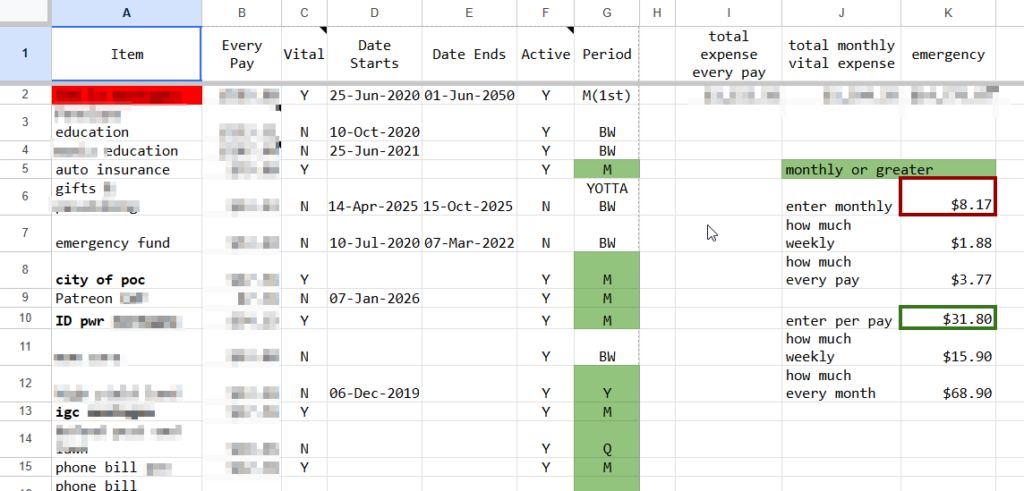
Every expense has a name, a frequency, a vital flag, and an active status. I can see my total monthly vital expenses, what hits every paycheck, and what’s quarterly or yearly so nothing sneaks up on me. It didn’t start this way — it grew as my life got more complex. But it all started with just tracking what came in and what went out.
If you want something that does more of the heavy lifting automatically, tools like YNAB or Monarch Money are worth exploring. But honestly? The tool matters way less than the habit.
Once that foundation is in place, everything else becomes clearer — whether that’s protecting your investments during uncertain times, or simply knowing you’re building toward something that actually matters — like I wrote about recently when thinking about what happy retirees do differently.
Start before you need it. Because one day — a job, a bill, a life event you didn’t see coming — something will change. And when it does, you’ll want a clear number in front of you, not a guess.
You’ve got this. Build your measuring stick today.